
Light
Direct Sun
A very bright position with controlled direct sun is suitable; although the grey-bronze epidermis may tolerate strong light, a lower-light plant must be acclimated gradually.
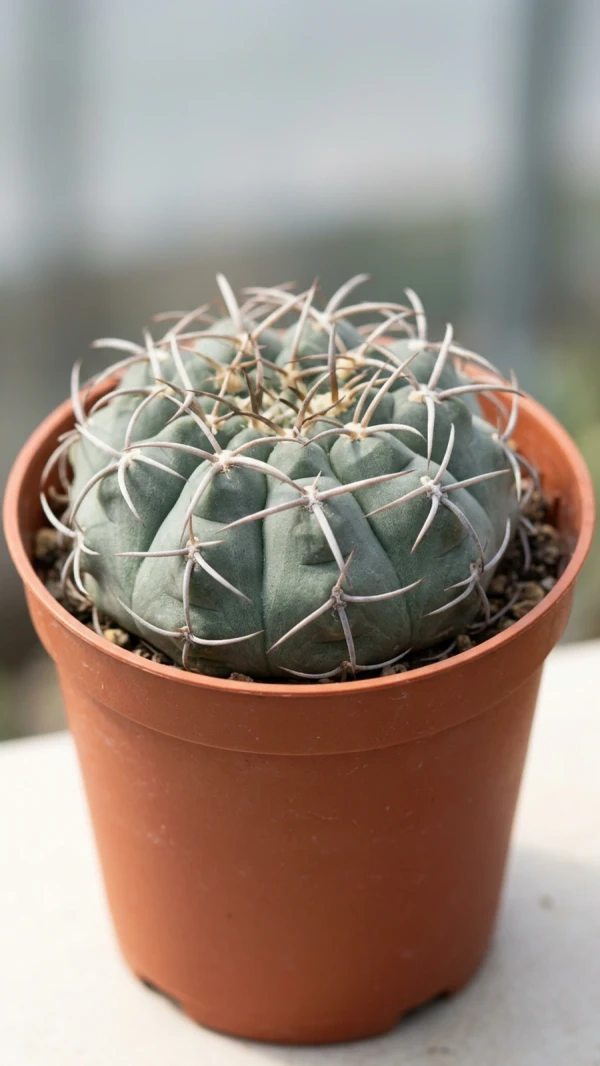
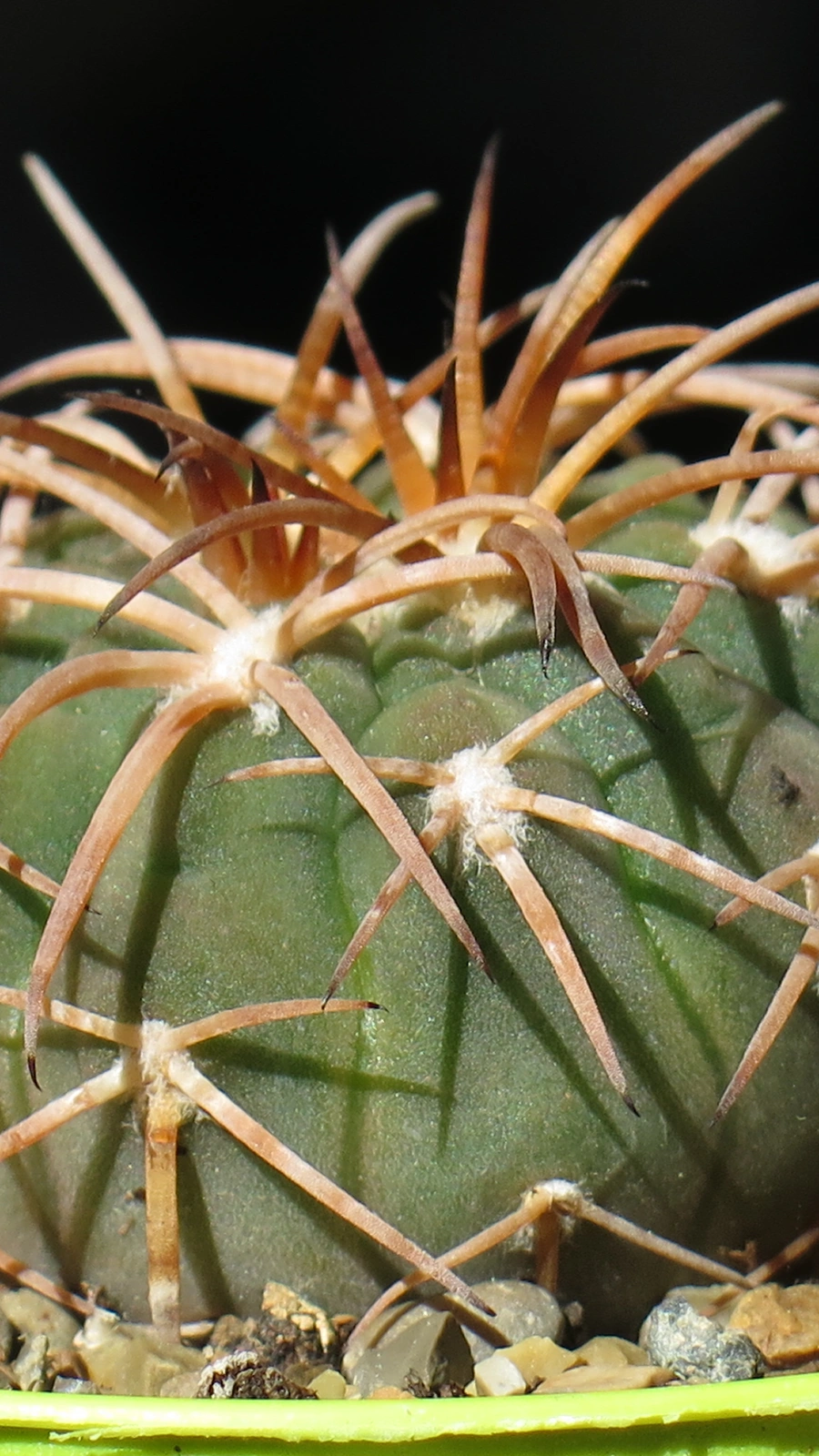 Reference image
Spegazzini's Chin Cactus
Gymnocalycium spegazzinii is a depressed-stemmed natural species of stony mountain habitats in north-western Argentina and Bolivia, notable for strong curved spines. A depressed-globose stem, grey-green to bronze-brown epidermis, broad ribs, and strong spines curving close to the stem are assessed together in identification. Unlike the taxonomy article, the botanical-dictionary layer explains the living plant's morphology, habitat context, and cultivation requirements.
The verified native range is north-western Argentina and Bolivia.1 The species grows on arid mountain slopes and stony ground with a broad, low stem; a wild population and a commercial pot form are not equivalent evidence. Cultivation should not imitate a landscape as decoration; it should provide fast oxygen return to the root zone, a controlled wet-dry cycle, and sufficient light.
A very bright position with controlled direct sun is suitable; although the grey-bronze epidermis may tolerate strong light, a lower-light plant must be acclimated gradually. A plant raised under lower light should not be moved abruptly into harsh sun; increase exposure over several weeks. Wet roots during cool weather are generally more dangerous than controlled dry coolness.
Do not use a fixed-day calendar. During active growth, water thoroughly only after the mix has dried throughout and let every excess drain away. Drying slows during cool or low-light periods, so watering naturally becomes less frequent. Use an airy, coarse, mineral-rich mix; avoid fine peat-heavy media that retain moisture around the root neck.
The accepted subsp. cardenasianum and subsp. spegazzinii are not species synonyms. Historical form names placed under subsp. spegazzinii are not moved to the parent species list. Stem colour, spine density, and flowering time vary among living specimens; a product photograph alone is neither a scientific diagnosis nor a record of a wild population.
The best-supported household concern is mechanical injury from the spines rather than a claim of chemical toxicity. Restrict access for children and pets. IUCN assesses the species as Least Concern. The category applies to wild populations and must not be confused with nursery stock or the separate ranges of accepted subspecies.
A very bright position with controlled direct sun is suitable; although the grey-bronze epidermis may tolerate strong light, a lower-light plant must be acclimated gradually.
Do not use a fixed calendar. Water deeply after complete drying and reduce frequency during cool or low-light periods.
A coarse, airy, mineral-rich, fast-draining cactus mix.
Spines present a mechanical injury risk. IUCN assesses the species as Least Concern. The category applies to wild populations and must not be confused with nursery stock or the separate ranges of accepted subspecies.
It is of moderate difficulty because of slow growth, strong-light requirements, and sensitivity to excess moisture.
north-western Argentina and Bolivia.[^1] [^1]: Plants of the World Online. “Gymnocalycium spegazzinii.” Accessed: 2026-08-04. https://powo.science.kew.org/taxon/urn:lsid:ipni.org:names:115497-2
